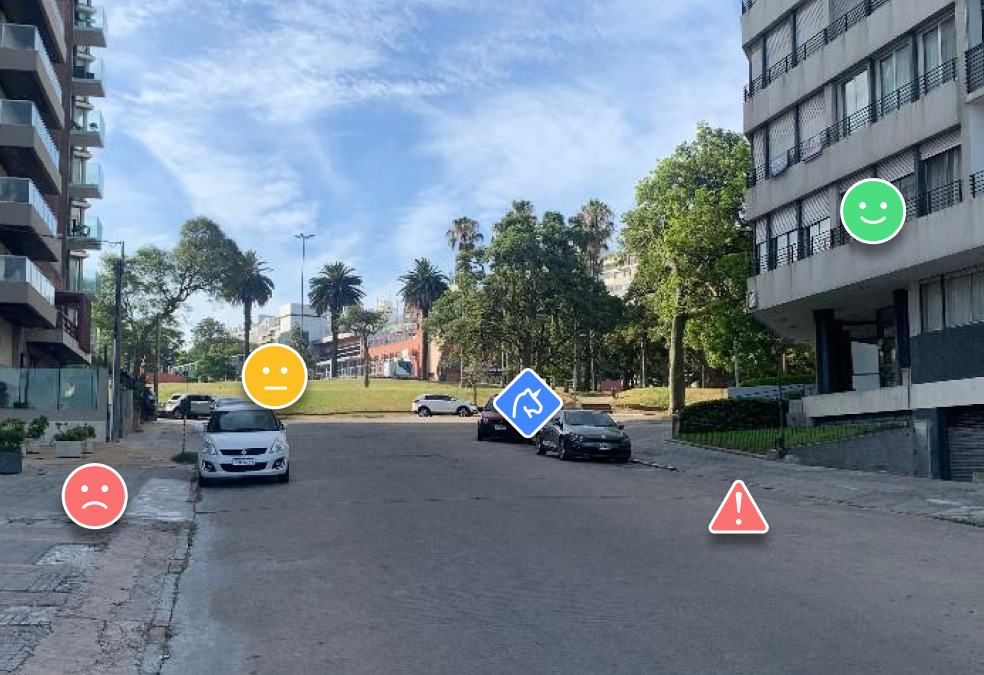
StreetSmart combines street design with lived experience.
Discover how streets affect your everyday life. Build a case for healthier, more
liveable streets to share with local leaders.
This photo doesn't have location data. Are you currently at the place where it was taken?
Did we get it right?
Let us know how we can improve. We read every submission.
Delete this analysis?
Are you sure you want to delete this analysis? This cannot be undone.
How streets and climate are connected
The way a street is designed can contribute to climate change, help reduce its causes, or
affect how well a place copes with its effects.
Urban heat
Streets with large areas of exposed asphalt, concrete and other hard surfaces absorb and
re-radiate heat, while trees, vegetation and shade help keep streets cooler. Shaded
surfaces can be substantially cooler than unshaded ones, sometimes by 10°C or more in
direct sun, while trees and vegetation cool streets further through shade and
evapotranspiration. Surface colour matters too: darker, low-albedo materials absorb more
solar energy, while lighter, more reflective surfaces absorb less. Fresh asphalt can
reflect as little as 5–10% of incoming solar energy compared with around 35–40% for new
concrete.
Stormwater and flooding
When rain falls on sealed streets, it cannot soak into the ground. In heavily impervious
areas, more than half of rainfall can become runoff, compared with around 10% in more
natural or permeable landscapes. Rain gardens, swales and permeable surfaces slow that
water down, absorb it and reduce runoff.
Motor traffic and transport emissions
Cars and other motor vehicles burn fuel or use electricity, and the more a street is
designed around driving, the more traffic and transport emissions it can support. More
road space can feed a cycle of car dependence: driving becomes easier, places spread
further apart, alternatives become less practical, and more road space is then demanded.
Reallocating street space to walking, cycling and public transport can help break that
cycle, reduce transport emissions and use street space more efficiently, freeing room
for trees, planting, drainage and public space.
Parking and land use
Large amounts of parking consume valuable urban land, reinforce car dependence and can
push development further apart, contributing to urban sprawl and longer journeys.
Parking also adds sealed surface and leaves less room for trees, drainage, walking and
cycling. Reducing parking can reverse that pattern: it frees space for lower-carbon
mobility, green infrastructure and public life, while supporting more compact, efficient
use of urban land.
Green infrastructure and vegetation
Trees and planting cool streets through shade and evapotranspiration, slow and absorb
rainwater, and store carbon. Urban forests have been found to be around 1.6°C cooler on
average than comparable non-green urban areas.
Surface treatment and soil permeability
What a street is made of matters. Asphalt and concrete shed water and store heat; soil,
planting and permeable surfaces allow more water to soak in and can reduce both runoff
and heat build-up.
Energy use
Street lighting and other infrastructure consume energy. Excessive or unnecessary energy
use can contribute to greenhouse-gas emissions. Renewable or efficient systems can
reduce emissions, but they do not make unnecessary energy use impact-free.
Community resilience and social infrastructure
Climate resilience is also social. Streets that make it easier for people to meet, know
and support one another can strengthen the local networks people rely on during
heatwaves, floods and other disruptions. Research on major heatwaves has found social
isolation to be associated with higher mortality risk.